

Free Oracle 1z1-076 Test Practice Test Questions Exam Dumps
Prepare Top Oracle 1z1-076 Exam Audio Study Guide Practice Questions Edition
Oracle 1z1-076 Exam Syllabus Topics:
| Topic | Details |
|---|---|
| Topic 1 |
|
| Topic 2 |
|
| Topic 3 |
|
| Topic 4 |
|
| Topic 5 |
|
| Topic 6 |
|
| Topic 7 |
|
| Topic 8 |
|
| Topic 9 |
|
NEW QUESTION # 22
Your Data Guard environment consists of these components and settings:
A primary database supporting an OLTP workload
A remote physical standby database
Real-time query is enabled
The redo transport mode is set to SYNC
The protection mode is set to Maximum Availability
Which two statements are true regarding the DelayMins database property for the standby database?
- A. It specifies a delay before the primary ships redo to the standby destination having DelayMins set.
- B. It can only be enabled for a configuration in Maximum Performance mode.
- C. It can only be enabled for a configuration in Maximum Availability mode.
- D. It allows user errors on the primary to be recovered by using the physical standby database.
- E. It enables you to bypass the default network timeout interval specified for the standby redo transport destination.
- F. It allows logical corruptions on the primary to be recovered by using the physical standby database.
Answer: D,F
NEW QUESTION # 23
Which four statements are true regarding SQL Apply filters for a logical standby database?
- A. They can be used to skip ALTE1 STEM and ALTER DATABASE commands.
- B. They can be used to skip all SQL statements executed on a specific pluggable database (PDB) within a standby multitenant container database (CDB).
- C. They can be used to skip CREATE TABLE commands.
- D. They can be used to skip execution of DML triggers on a table while allowing the DML to execute.
- E. They can only be used to skip DML statements on a table.
- F. They can be used to stop SQL apply if it encounters an error.
- G. They can be used to skip ALTER TABLE commands on specific tables.
Answer: A,C,D,G
Explanation:
Based on the Oracle Database 19c documentation, the correct answers about SQL Apply filters for a logical standby database are:
A). They can be used to skip execution of DML triggers on a table while allowing the DML to execute.
B). They can be used to skip CREATE TABLE commands.
C). They can be used to skip ALTER SYSTEM and ALTER DATABASE commands.
G). They can be used to skip ALTER TABLE commands on specific tables.
Comprehensive Detailed Explanation:
SQL Apply filters in a logical standby database can be set to control which SQL operations are applied to the standby. These filters allow for certain commands to be skipped, ensuring that they do not impact the standby database. For example, filters can be used to skip the execution of DML triggers to prevent them from firing during SQL Apply, while still allowing the underlying DML to be executed on the logical standby database. This is particularly useful when certain triggers are not desired to run in a standby environment. CREATE TABLE, ALTER SYSTEM, ALTER DATABASE, and specific ALTER TABLE commands can also be skipped using SQL Apply filters to prevent unwanted structural changes or administrative operations from affecting the logical standby database. These capabilities provide a level of control to ensure that the logical standby database reflects only the desired state of the primary database.
Reference:
Oracle Database SQL Language Reference and Oracle Data Guard Concepts and Administration guide offer comprehensive details on the use of SQL Apply filters, including the range of SQL statements that can be influenced by these filters in a logical standby database environment.
NEW QUESTION # 24
Which THREE are among the various tasks performed by the Data Guard Monitor (DMON) process?
- A. maintaining information about all members of the broker configuration in binary configuration files.
- B. communicating with dkon processes in other database instances that are part of the broker configuration
- C. communicating with the DMON process of the observer to monitor a primary database in case a fast start failover is required
- D. activating role-based services appropriately in the various database instances of the configuration, based on the database role
- E. performing role transitions when switchover requests are made
Answer: A,D,E
Explanation:
The Data Guard Monitor (DMON) process is a key component of Oracle Data Guard. It plays a crucial role in managing and monitoring the state of both the primary and standby databases in a Data Guard configuration.
* Performing role transitions when switchover requests are made (A): DMON is responsible for coordinating the switchover process between the primary and standby databases. This involves safely transitioning the roles of the databases to ensure data protection and availability.
* Maintaining information about all members of the broker configuration in binary configuration files (B): DMON maintains detailed information about the databases in the Data Guard configuration, including their roles, states, and network addresses. This information is stored in binary configuration files, which are used by the Data Guard Broker to manage the Data Guard environment.
* Activating role-based services appropriately in the various database instances of the configuration, based on the database role (C): DMON activates services that are appropriate for the role of each database in the Data Guard configuration. For example, it may activate different services on a primary database than on a standby database, based on the specific requirements of each role.
References:
* Oracle Data Guard Concepts and Administration
* Oracle Data Guard Broker documentation
NEW QUESTION # 25
On your logical standby database, you specified these rules: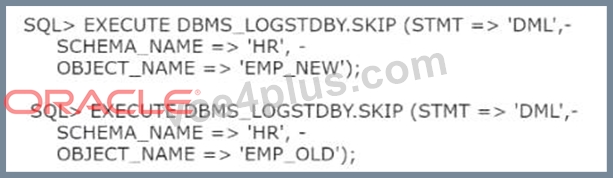
After completion of the weekend batch cycle you attempt to delete the SQL Apply filters:
Which is TRUE regarding the execution of the UNSKIP procedure?
- A. It succeeds only if all DML statements executed on the primary have been applied on the logical standby deleting the SQL Apply filter.
- B. It deletes both the SQL Apply filters.
- C. It succeeds but the SQL Apply filters are not deleted.
- D. It succeeds only if SQL apply is stopped before deleting the SQL Apply filter.
- E. It returns an error because the syntax to delete a SQL Apply filter must specify the same object names as specified when the filter was added.
Answer: B
Explanation:
The execution of the UNSKIP procedure is designed to remove SQL Apply filters that have been previously set up on a logical standby database. Based on the provided statements, the UNSKIP procedure is directed to delete any SQL Apply filters for DML statements associated with objects in the 'HR' schema that start with
'EMP'. Since both SKIP procedures had the same schema name ('HR') and statement type ('DML'), and the UNSKIP procedure uses a wildcard (%) for the object name, it will successfully remove both of the SQL Apply filters for 'EMP_NEW' and 'EMP_OLD', as both object names match the pattern provided in the UNSKIP procedure.
References:Oracle's Data Guard documentation and SQL Language Reference provide insights into managing SQL Apply filters on a logical standby database using the DBMS_LOGSTDBY package. This includes adding and removing filters through SKIP and UNSKIP procedures.
NEW QUESTION # 26
Which three actions are performed by the START PLAN procedure of the DBMS ROLLING package?
- A. building a LogMiner dictionary on the primary database instance
- B. starting media recovery on all the Leading Group Standby databases
- C. converting the designated physical standby database into a logical standby database
- D. creating a guaranteed restore point on the primary database
- E. creating a guaranteed restore point on the standby databases
- F. switching the primary database to the logical standby role
Answer: A,D,E
Explanation:
The DBMS_ROLLING package facilitates a rolling upgrade process across a Data Guard configuration. The START PLAN procedure in particular handles several critical actions, including:
* Creating a guaranteed restore point on the standby databases (B): This ensures that the standby databases can be reverted to their state before the rolling upgrade process in case of any issues.
* Building a LogMiner dictionary on the primary database instance (C): This is necessary for logical standby databases to interpret redo data during the SQL Apply process.
* Creating a guaranteed restore point on the primary database (D): Similar to the standby databases, this ensures that the primary database can be reverted to a known good state if necessary.References:
* Oracle Database PL/SQL Packages and Types Reference
* Oracle Data Guard Concepts and Administration Guide
NEW QUESTION # 27
Examine the Data Guard configuration:
DGMGRL> show configuration;
Configuration - Animals
Protection Mode: Max Availability
Databases:
dogs - Primary database sheep
- Physical standby database cats
- Physical standby database
Fast-Start Failover: DISABLED
Configuration Status: SUCCESS
An attempt to enable fast-start failover raises an error:
DGMGRL> enable fast_start failover;
Error: ORA-16693: requirements not met for enabling fast-start failover Failed.
Identify three possible reasons for this error.
- A. The LogXptMode property is set to FASTSYNC on Cats while Sheep is the target standby database.
- B. The LogxptModr property is set to async on Sheep while Sheep is the target standby database.
- C. The fastStartFailoverTarget property is not set on Dogs.
- D. The LogXptMode property is set to async on Dogs.
- E. The LogXptMode property is set to fastsync on Dogs.
Answer: B,C,D
Explanation:
When enabling fast-start failover, certain conditions must be met:
The fastStartFailoverTarget property is not set on Dogs (A): The primary database (Dogs) needs to have a fast-start failover target configured for the operation to succeed.
The LogXptMode property is set to ASYNC on Sheep while Sheep is the target standby database (B): Fast-start failover requires synchronous redo transport (SYNC or FASTSYNC) to ensure zero data loss, which is a prerequisite for enabling the feature.
The LogXptMode property is set to ASYNC on Dogs (D): Similar to the previous point, the primary database must be configured to use synchronous redo transport for the fast-start failover to be possible.
Reference:
Oracle Data Guard Broker documentation
Oracle Database Error Messages Guide
NEW QUESTION # 28
Your Data Guard environment consists of these components and settings:
1. A primary database
2. Two remote physical standby databases
3. The redo transport mode is set to sync
4. Real-time query is enabled for both standby databases
5. The DB_BLOCK_CHECKING parameter is set to TRUE on both standby databases You notice an increase in redo apply lag time on both standby databases.
Which two would you recommend to reduce the redo apply lag on the standby databases?
- A. Increase the size of standby redo log files on the standby databases.
- B. Increase the size of the buffer cache on the physical standby database instances.
- C. Increase the number of standby redo log files on the standby databases.
- D. Lower DB_BLOCK_CHECKING to MEDIUM or low on the standby databases.
- E. Decrease the redo log file size on the primary database.
Answer: A,D
Explanation:
To reduce the redo apply lag on standby databases, one could increase the size of the standby redo log files. Larger redo log files can accommodate more redo data, which may reduce the frequency of log switches and allow for more continuous application of redo data. Additionally, lowering the DB_BLOCK_CHECKING parameter to MEDIUM or LOW on the standby databases can help improve redo apply performance. High block checking can impose additional CPU overhead during the application of redo data, potentially increasing apply lag times. By reducing the level of block checking, you can lessen this overhead and help reduce the apply lag .
NEW QUESTION # 29
In Oracle Database 19c, you can set the value of database initialization parameters in a database using the EDIT DATABASE... SET PARAMETER Command:
DGMGRL> EDIT DATABASE 'boston' SET PARAMETER log_archive_trace - 1;
Which THREE statements are TRUE about the command?
- A. The EDIT DATABASE PARAMETER command can be used to set the value of a static parameter in a database.
- B. The database must be available when the above command is run.
- C. The value set using this command is directly stored in the broker configuration file.
- D. The edit database parameter command can only be used to modify the value of a dynamic parameter in a database.
- E. The value set using this command is directly applied to the boston database.
Answer: B,D,E
Explanation:
The EDIT DATABASE...SET PARAMETER command in Data Guard Management (DGMGRL) is used to modify the value of initialization parameters for a database within a Data Guard configuration. This command can be used to modify both static and dynamic parameters, but if a static parameter is changed, the new value will take effect only after the database is restarted. The database must be up and running for the command to execute, and the values set using the command are directly applied to the specified database (in this case,
'boston') .
NEW QUESTION # 30
Your Data Guard configuration consists of these components and settings:
1. A primary database
2. A remote physical standby database
3. Real-time query is enabled
4. Redo transport mode is synchronous
5. Protection mode is maximum availability
6. The Data Guard broker is used
You notice that the standby destination fails to acknowledge reception of redo within net_timeout period of time.
Which is true in this scenario?
- A. The protection mode will automatically change to Maximum Performance.
- B. Synchronous redo transport mode connections to the standby database are terminated.
- C. Real-time query will be disabled on the physical standby.
- D. The physical standby database instance is shut down by the Data Guard broker.
Answer: B
Explanation:
In a Data Guard configuration where the protection mode is set to Maximum Availability and synchronous redo transport is enabled, if the standby destination fails to acknowledge the reception of redo within the net_timeout period, the primary database will terminate the synchronous redo transport mode connections to the standby database to protect the primary database from hanging (C). The primary database then operates in a Maximum Performance mode until the issue is resolved. This behavior ensures that the primary database can continue to process transactions even when the standby database is temporarily unavailable.
References:The Oracle Data Guard Broker documentation and Oracle Data Guard Concepts and Administration guide detail the behavior of different protection modes and the response to network timeouts, including the fallback to asynchronous redo transport to maintain primary database availability.
NEW QUESTION # 31
Active Data Guard (ADG) databases are widely used to offload reporting or ad hoc query-only jobs from the primary database. Reporting workload profile is different from the primary database and often requires tuning.
Which tool is used to tune SQL workloads running on an ADG database?
- A. Automatic Diagnostic Database Monitor (ADDM)
- B. SQL Tuning Advisor
- C. Standby Statspack
- D. In-Memory Active Session History (ASH)
- E. Automatic Workload Repository (AWR)
Answer: E
Explanation:
AWR collects, processes, and maintains performance statistics for problem detection and self-tuning purposes. In an Active Data Guard environment, where the physical standby database can be used for read-only workloads, AWR can be instrumental in identifying performance bottlenecks and areas for optimization. It provides detailed reports that include wait events, time model statistics, and active session history, making it an invaluable tool for tuning SQL queries and overall database performance in an ADG setup.
NEW QUESTION # 32
Examine this query and its output: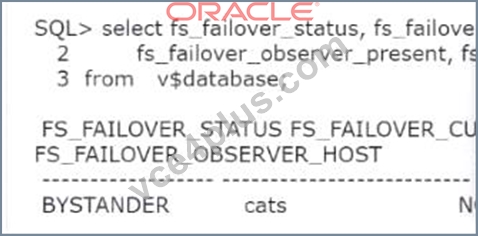
Which two statements are true?
- A. The master observer is not connected to the database on which the query was executed.
- B. The master observer is connected to the database on which the query was executed.
- C. The master observer is not running, but should run on ol7.example.com.
- D. The master observer is currently running on ol7.example.com.
- E. Cats is a bystander database.
Answer: A,E
Explanation:
D: The database role indicated by FS_FAILOVER_STATUS as BYSTANDER implies that the database is a standby database in the Data Guard configuration. This means the database is neither a primary database nor an active failover target.
E: Since the FS_FAILOVER_OBSERVER_HOST column shows cats, it suggests that this is the host on which the observer would run. However, because the FS_FAILOVER_OBSERVER_PRESENT column is not shown, we cannot definitively state if the observer is currently connected or not. If FS_FAILOVER_OBSERVER_PRESENT is 'YES', the observer is connected, if 'NO', then it's not. In the absence of this column's output, the best assumption based on the available data is that the observer is not connected.
The output shows that the FS_FAILOVER_STATUS is BYSTANDER, which indicates that the database in question is not actively involved in a fast-start failover configuration as a primary or standby. It is in a bystander role, meaning that while it is part of a Data Guard configuration, it is neither a target for failover nor actively participating in failover operations. Additionally, FS_FAILOVER_OBSERVER_HOST shows
'cats', which indicates the host where the observer process is expected to run. However, since there is no information about the observer being present, we can infer that although 'cats' is designated for the observer to run, the observer is not currently connected to this database.
ReferencesOracle documentation on Data Guard configurations and the V$DATABASE view which provides information about the fast-start failover status and observer host.
NEW QUESTION # 33
Which two are true about managing and monitoring Oracle container databases in a Data Guard environment using the broker?
- A. If the primary database is a container database, then a physical standby may be a non-container database.
- B. All broker actions execute at the root container for container databases.
- C. After a role change, the broker opens all Pluggable databases (pdbb) on the new primary.
- D. If the primary database is not a container database, then a standby may be a container database.
- E. If the primary database is a container database, then a logical standby may be a non-container database.
Answer: B,C
Explanation:
In the context of Oracle Data Guard and container databases (CDBs) managed by Data Guard Broker:
All broker actions execute at the root container for container databases (D): When using Data Guard Broker to manage a CDB, the actions performed by the broker are executed at the level of the root container. This is because the root container maintains the control and configuration information that applies to the entire CDB, including all of its pluggable databases (PDBs).
After a role change, the broker opens all Pluggable databases (PDBs) on the new primary (E): Following a role transition such as a switchover or a failover, Data Guard Broker ensures that all PDBs within the CDB of the new primary database are opened, which is essential to resume operations of the PDBs without manual intervention.
Reference:
Oracle Data Guard Broker documentation
Oracle Multitenant Administrator's Guide
NEW QUESTION # 34
Examine this validate command:
DGMGRL> VALIDATE DATABASE VERBOSE "<database name>";
Which THREE statements are TRUE?
- A. The command uses information available in various Oracle Data Guard views as well as the Automatic Diagnostic Repository.
- B. The command can be used for a logical standby database.
- C. The command performs a comparison of SPFILE entries between the primary database and a specified standby database.
- D. The command performs a comprehensive set of database checks prior to a role change.
- E. The command performs network connectivity checks between members of a broker configuration.
Answer: B,D,E
Explanation:
* The command performs a comprehensive set of database checks prior to a role change (A): The VALIDATE DATABASE command in Data Guard Manager (DGMGRL) is designed to perform an exhaustive check of a specified database's readiness for a role change, such as a switchover or failover.
* The command performs network connectivity checks between members of a broker configuration (C): One of the checks includes verifying that the necessary network connectivity exists between the databases in a Data Guard Broker configuration.
* The command can be used for a logical standby database (D): The VALIDATE DATABASE command is versatile and can be used for both physical and logical standby databases to ensure their readiness for role changes.
References:
* Oracle Data Guard Broker documentation
* Oracle Data Guard Concepts and Administration Guide
NEW QUESTION # 35
Which two are prerequisites for configuring Transaction Guard in a Data Guard environment?
- A. Ensure that connection descriptors for database clients use the failover clause with the COMMIT_OUTCOME parameter set to TRUE.
- B. Set INSTANCE_NAME identically on all the Data Guard Configuration databases and modify the local service name on the client to include a CONNECTION_LIST containing all the standby hosts.
- C. Create a database service with COMMIT_OUTCOME set to TRUE and ensure that the service is statically registered with the default listener on the primary host.
- D. Grant execute permission on the DBMS_APP_CONT package to relevant database schema owners.
- E. Create a database service with COMMIT_OUTCOME set to TRUE, and ensure clients use that service to connect to the database instance.
Answer: D,E
NEW QUESTION # 36
Which three are true concerning database states after a successful switchover?
- A. If the former primary database became a physical standby database it will always be open readonly.
- B. If the former primary database became a logical standby database it will be open read-write.
- C. If the former primary database became a logical standby database it will be in mount state.
- D. The former primary database will always be open.
- E. If the former primary database became a physical standby database it will be in the same state as the former physical standby database.
- F. The new primary database will be open read-write.
Answer: B,E,F
Explanation:
After a successful switchover operation in a Data Guard environment, the new primary database (the former standby) will be open read-write (option A). If the former primary database transitions to a logical standby database, it will also be open read-write (option C), allowing it to apply redo data while servicing read-only queries. The former primary, if converted to a physical standby, will adopt the state that the former physical standby database was in prior to the switchover, which can vary based on the configuration prior to the switchover (option D). The state of a physical standby database can range from mounted to open read-only, depending on whether Real-Time Query was enabled. Thus, the exact state will depend on the pre-switchover setup. It's also essential to highlight that options B and E suggest specific states for a former primary turned logical standby, and a former primary turned physical standby, respectively, but these states are not fixed and depend on the configurations set up by the database administrators. Reference: The answers are corroborated by Oracle's documentation on Data Guard switchovers, specifically in the Oracle Data Guard Concepts and Administration guide, which explains the roles and states of databases in a Data Guard configuration before and after switchovers.
NEW QUESTION # 37
Which TWO statements are true about database parameters for databases in a Data Guard environment?
- A. If DB_RECOVERY_FILE_DEST is specified, then LOG_ARCHIVE_DEST_n is not required for local archive logs.
- B. LOG_FILE_NAME_CONVERT applies to online redo logs and archived logs.
- C. The databases that are part of a Data Guard configuration must have different DB_UNIQUE_NAME initialization parameters.
- D. DB_FILE_NAME_CONVERT is only required if the standby database is on the same host as the primary database.
- E. COMPATIBLE must have identical values for primary and standby databases.
Answer: C,E
NEW QUESTION # 38
Your Data Guard environment consists of these components and settings:
1. A primary database
2. A remote physical standby database
3. Real-time query is enabled.
4. The redo transport mode is set to SYNC.
5. The protection mode is set to Maximum Availability.
You notice that queries executed on the physical standby database receive errors: ORA-03172:
STANDBY_MAX_DATA_DELAY of 15 seconds exceeded. Which two would you recommend to avoid this error?
- A. Increase the network bandwidth between the primary and standby databases.
- B. Increase the size of the buffer cache on the standby database instance.
- C. Change the protection mode to Maximum Performance.
- D. Change the protection mode to Maximum Protection.
- E. Reduce I/O latency for the storage used by the primary database.
- F. Increase the number of standby redo log files on the primary database.
Answer: A,E
Explanation:
The ORA-03172: STANDBY_MAX_DATA_DELAY error indicates that the real-time query on the physical standby database is experiencing delays beyond the specified maximum data delay threshold. Increasing the network bandwidth (Option E) can enhance the speed at which redo data is transferred from the primary to the standby database, thereby reducing the likelihood of exceeding the STANDBY_MAX_DATA_DELAY threshold. Reducing I/O latency on the primary database's storage (Option B) ensures that redo data is generated and shipped more efficiently, further mitigating the risk of delay. These actions, focused on optimizing data transfer and processing speed, address the root causes of the ORA-03172 error in a synchronous Data Guard configuration operating in Maximum Availability mode.
NEW QUESTION # 39
Which TWO statements are true about Far Sync instances?
- A. They do not work with Snapshot Standby databases.
- B. They work in Maximum Availability mode.
- C. They work in Maximum Protection mode.
- D. They work in Maximum Performance mode.
- E. They do not work with Logical Standby databases.
Answer: D,E
NEW QUESTION # 40
Examine this validate command:
DGMGRL> VALIDATE DATABASE VERBOSE "<database name>";
Which THREE statements are TRUE?
- A. The command uses information available in various Oracle Data Guard views as well as the Automatic Diagnostic Repository.
- B. The command can be used for a logical standby database.
- C. The command performs a comparison of SPFILE entries between the primary database and a specified standby database.
- D. The command performs a comprehensive set of database checks prior to a role change.
- E. The command performs network connectivity checks between members of a broker configuration.
Answer: B,D,E
Explanation:
The command performs a comprehensive set of database checks prior to a role change (A): The VALIDATE DATABASE command in Data Guard Manager (DGMGRL) is designed to perform an exhaustive check of a specified database's readiness for a role change, such as a switchover or failover.
The command performs network connectivity checks between members of a broker configuration (C): One of the checks includes verifying that the necessary network connectivity exists between the databases in a Data Guard Broker configuration.
The command can be used for a logical standby database (D): The VALIDATE DATABASE command is versatile and can be used for both physical and logical standby databases to ensure their readiness for role changes.
Reference:
Oracle Data Guard Broker documentation
Oracle Data Guard Concepts and Administration Guide
NEW QUESTION # 41
Your Data Guard environment has two remote physical standby databases.
Client applications use the local naming method to connect to the primary database instance.
You want applications to automatically connect to the new primary database instance in case of a switchover or a failover.
Which set of actions will fulfill this requirement?
- A. Set the LOCAL_LISTENER parameter for all the database instance to register services with the default listener on the primary database host.
- B. Set the INSTANCE NAME parameter identically on all databases; modify the connection descriptor on client applications to include all the standby hosts and connect to the database instance using that service name.
- C. Set DB_NAME and DB_UNIQUE_NAME identically on all databases; modify the connection descriptors on client applications to include all the standby hosts and connect to the database instance using that service name.
- D. Create a database service on the primary database that is started automatically by a trigger, when the database role is PRIMARY; modify the connection descriptors used by client applications to include all the standby hosts and connect to the database instance using that service name.
Answer: D
Explanation:
For seamless client redirection in a Data Guard environment, the following steps should be taken:
* Create a database service on the primary database that is started automatically by a trigger when the database role is PRIMARY (B): This ensures that the service is only available on the primary database and is automatically started after a role transition due to switchover or failover.
* Modify the connection descriptors used by client applications to include all the standby hosts and connect to the database instance using that service name (B): Client applications use the connection descriptors that include all potential primary hosts (i.e., the current primary and all standbys). This enables clients to connect to whichever database is currently acting as the primary using the service name.References:
* Oracle Data Guard Concepts and Administration Guide
* Oracle Real Application Clusters Administration and Deployment Guide
NEW QUESTION # 42
......
Go to 1z1-076 Questions - Try 1z1-076 dumps pdf: https://dumpsstar.vce4plus.com/Oracle/1z1-076-valid-vce-dumps.html