

Network-Security-Essentials Certification Overview - [Mar 15, 2025] Latest Network-Security-Essentials PDF Dumps
The Best WatchGuard Network-Security-Essentials Study Guides and Dumps of 2025
NEW QUESTION # 16
You have just configured Mobile VPN with IKEv2 for your customer. By default, authenticated Mobile VPN users are allowed to send traffic to all Firebox networks through the VPN.
- A. False
- B. True
Answer: A
Explanation:
In the default configuration ofMobile VPN with IKEv2, authenticated VPN users are only allowed access to specified networks or resources as defined by the VPN policy. They do not automatically have access to all Firebox networks through the VPN. To enable access to specific networks, administrators need to configure access routes explicitly within the Mobile VPN settings.
NEW QUESTION # 17
The Firebox can scan the contents of encrypted zip files with Gateway AntiVirus when HTTPS content inspection is enabled.
- A. False
- B. True
Answer: A
Explanation:
The Firebox cannot scan the contents of encrypted zip files even if HTTPS content inspection is enabled.
HTTPS content inspection allows the Firebox to inspect encrypted HTTPS traffic by decrypting it. However, the content within encrypted zip files remains inaccessible to Gateway AntiVirus scanning because the encryption key for the zip file is not available to the Firebox. This limitation is consistent with standard network security practices, where encrypted files need to be decrypted with a known key before content scanning can occur.
NEW QUESTION # 18
When Mobile VPN is enabled, remote users receive the domain name and DNS servers from the Firebox Network Configuration by default.
- A. False
- B. True
Answer: B
Explanation:
WhenMobile VPNis enabled on a Firebox, remote users receive network configuration settings, including domain nameandDNS server informationfrom the Firebox by default. This setupensures that remote users can resolve internal domain names and access network resources as though they were connected directly to the internal network. This functionality is essential for maintaining consistent user experience and connectivity while working remotely.
NEW QUESTION # 19
When you configure a Branch Office VPN tunnel to a third-party device, AES-GCM encryption is recommended for:
- A. Troubleshooting purposes
- B. Connections to third-party firewalls only
- C. Routing over a BOVPN
- D. Better performance and throughput when supported by both VPN endpoints
- E. Better uptime because of additional keep-alive options
Answer: D
Explanation:
AES-GCM (Galois/Counter Mode)encryption is recommended for VPNs because it provides strong encryption with high performance and low overhead, making it an ideal choice for environments where both endpoints support it. AES-GCM combines encryption and authentication in a single step, resulting in faster processing compared to traditional encryption modes that handle these tasks separately. This mode is advantageous for maintaining high throughput in VPN tunnels, especially beneficial for branch office or inter- site VPNs where performance is critical.
NEW QUESTION # 20
You have five public IP addresses available from your ISP. When you create a Static NAT action, you want to specify one of the public IP addresses for inbound traffic but do not see it in the IP address drop-down list.
How can you change the Firebox configuration to see additional public IP addresses in the Static NAT action?
(Select one.)
- A. Add secondary IP addresses to the external interface
- B. Configure 1-to-1 NAT for your entire subnet
- C. Add the IP addresses to the Dynamic NAT configuration
- D. Add the public IP addresses to the From field of the policy that uses the Static NAT action
- E. Enable the Set Source IP option in the policy
Answer: A
Explanation:
To use additional public IP addresses in a Static NAT action, you need to add them as secondary IP addresses to the external interface on the Firebox. By adding these IPs as secondary addresses, they become selectable options in the Static NAT configuration, allowing inbound traffic to be routed based on specific public IPs allocated by the ISP.
NEW QUESTION # 21
Which of these statements are true for this log message? (Select three.)
- A. The connection used an HTTP Proxy
- B. The connection was denied
- C. Gateway AntiVirus detected a virus
- D. The connection used an HTTP Packet Filter
- E. Application Control detected the application as a virus
- F. The URL path matched the proxy content type restrictions
Answer: A,B,C
Explanation:
Analyzing a typical Firebox log message for a denied connection with an associated virus detection involves recognizing multiple elements:
* HTTP Proxy Detection (C): If the connection utilized an HTTP proxy, this is typically noted in the log. Firebox's HTTP proxy is often used to inspect and manage web traffic, including scanning for malicious content.
* Gateway AntiVirus Detection (D): This service scans HTTP traffic for malware and will generate log messages if it identifies a virus. When a virus is detected, the action taken is generally to block the connection.
* Connection Denial (E): When a threat is detected (e.g., a virus via Gateway AntiVirus), Firebox policies are configured to deny the connection to prevent potential infection or data breaches. This is logged as a denied connection.
Other options, such as Application Control detecting a virus or the use of an HTTP Packet Filter, are not relevant in this context based on the function of HTTP proxies and Gateway AntiVirus in Firebox logs.
NEW QUESTION # 22
Which of the following management interfaces can provide real-time diagnostic information? (Select two.)
- A. Log and Report Server
- B. Fireware Web UI
- C. Policy Manager
- D. Firebox System Manager
- E. Dimension
Answer: B,D
Explanation:
The Firebox System Manager (FSM) and Fireware Web UI are two key interfaces in Firebox devices for local management that offer real-time diagnostic information.
* Firebox System Manager (FSM): FSM provides a graphical interface that allows administrators to monitor traffic in real-time, view logs, and analyze performance metrics directly from the device. This interface includes specific tools such as Traffic Monitor and Subscription Services, which display current activity and status of security services, respectively. FSM is highly effective in immediate diagnostics due to its continuous update capabilities.
* Fireware Web UI: Fireware Web UI, another management interface available in Firebox, offers similar diagnostic functionalities but is accessible through a web browser. This interface is essential for remote diagnostics and provides real-time views on device status, traffic, and security service health.
The Web UI is particularly beneficial for quick access without needing specialized client software like FSM, making it convenient for on-the-go monitoring.
These two interfaces are central to Firebox management and are designed to streamline real-time monitoring and diagnostics, ensuring network health is visible and manageable at all times.
NEW QUESTION # 23
You bought a new Firebox and want to use the configuration from an existing Firebox you already configured. The best way to migrate the configuration is to restore a backup image from the existing Firebox to the new Firebox, then add the new feature key.
- A. False
- B. True
Answer: B
Explanation:
When migrating configurations from one Firebox to another, restoring a backup image from the existing Firebox to the new one is a valid and efficient method. This approach will transfer all configuration settings, policies, and security settings to the new Firebox. After restoring the backup, you need to add the new feature key specific to the new Firebox, as feature keys are unique to each device. This method preserves the existing configurations while adapting the setup for the new hardware.
NEW QUESTION # 24
What are some advantages of BOVPN virtual interfaces (route-based VPN) over classic policy-based BOVPNs? (Select two.)
- A. More flexible routing options
- B. Additional encryption options
- C. Increased BOVPN throughput
- D. Additional keep-alive options
- E. Supports VPN connectivity to cloud services
Answer: A,E
Explanation:
BOVPN virtual interfaces (route-based VPNs)offer several advantages over traditional policy-based BOVPNs:
* Supports VPN connectivity to cloud services (A): Route-based VPNs can more easily integrate with cloud environments, as they use routing rather than specific policies, making it possible to route traffic to various cloud services and manage cloud-based VPN connections.
* More flexible routing options (C): Route-based VPNs allow administrators to define more granular routing rules using standard IP routing tables. This flexibility supports complex network architectures and multiple routes for redundancy or load balancing.
These features make route-based VPNs more adaptable to modern network needs, particularly in hybrid and multi-cloud environments.
NEW QUESTION # 25
You have an existing network infrastructure built out that uses tagged and untagged VLAN networks. Based on the diagram below, which VLANs must you add to the Firebox interface? (Select one.)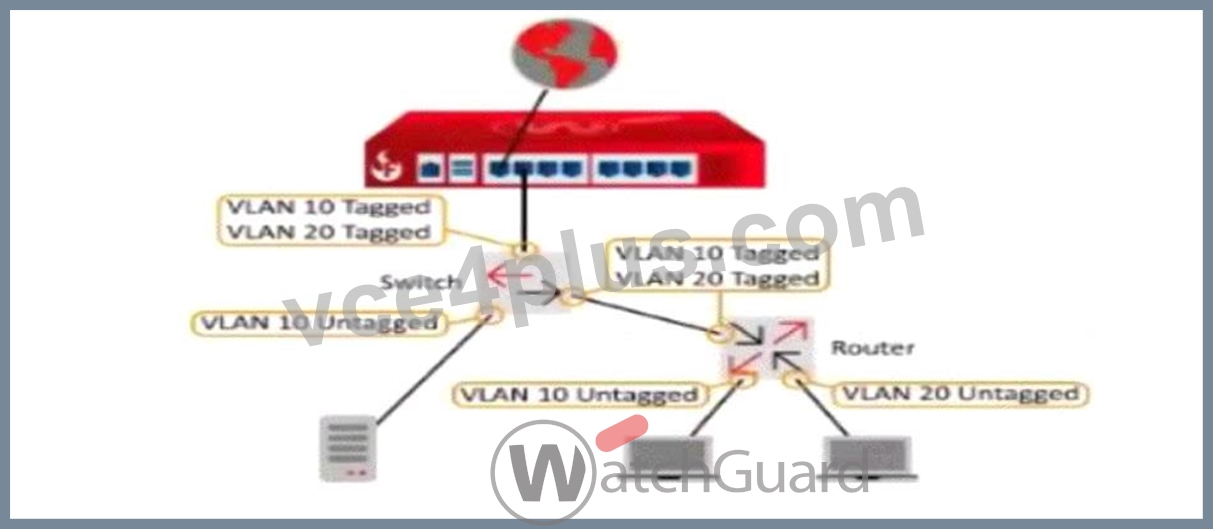
- A. VLAN 10 Untagged and VLAN 20 Tagged
- B. VLAN 10 Untagged, VLAN 10 Tagged, and VLAN 20 Tagged
- C. VLAN 10 Untagged and VLAN 20 Untagged
- D. VLAN 10 Tagged and VLAN 20 Untagged
- E. VLAN 10 Tagged and VLAN 20 Tagged
Answer: E
Explanation:
Based on the diagram provided, the Firebox connects to a switch with VLAN 10 and VLAN 20 as tagged traffic. The connection between the Firebox and the switch shows that both VLAN 10 and VLAN 20 are tagged, indicating that traffic for these VLANs will be carried over a single trunk link to the Firebox.
To properly configure the Firebox to handle this setup, you need to addVLAN 10 TaggedandVLAN 20 Taggedto the Firebox interface, as this configuration will allow the Firebox to interpret tagged packets for both VLANs from the switch. Untagged configurations are not applicable here since the Firebox interface expects tagged traffic for both VLANs on the trunk connection.
NEW QUESTION # 26
Which WatchGuard tools can you use to review the traffic log messages generated by your Firebox? (Select three.)
- A. Status Report
- B. FireWatch
- C. WatchGuard Cloud
- D. Policy Manager
- E. Dimension
- F. Traffic Monitor
Answer: B,E,F
Explanation:
* FireWatch: FireWatch provides a visual interface to monitor traffic and review log messages related to network activities on the Firebox. It offers real-time visibility into network usage, highlighting application activity and bandwidth utilization, which helps in analyzing traffic patterns and reviewing logs.
* Traffic Monitor: Traffic Monitor is an integral part of the Firebox System Manager, which displays detailed logs of network traffic. Administrators can use Traffic Monitor to review live traffic logs, filter traffic based on criteria, and troubleshoot network issues by examining these logs.
* Dimension: WatchGuard Dimension is a cloud-based logging and reporting solution that aggregates log messages from multiple Fireboxes. Dimension provides comprehensive reporting and enables administrators to analyze traffic patterns, detect potential threats, and generate detailed log-based reports for security audits and monitoring.
These tools are commonly used in WatchGuard environments for reviewing traffic log messages and ensuring thorough monitoring of network activities.
NEW QUESTION # 27
You can run TCP Dump directly from the Firebox.
- A. False
- B. True
Answer: A
Explanation:
You cannot runTCP Dumpdirectly from a Firebox device. While Firebox has various monitoring tools such as Traffic Monitor and Firebox System Manager, it does not natively support TCP Dump, which is a command-line tool primarily available on Linux-based systems. Instead, packet captures and traffic monitoring need to be handled through Firebox-specific tools or by exporting logs to external devices for further analysis.
NEW QUESTION # 28
Before packets are examined by Default Threat Protection, they are processed by firewall policies in top- down order.
- A. False
- B. True
Answer: B
Explanation:
In Firebox configuration, packets are processed by firewall policies in atop-down orderbefore they reach Default Threat Protection. This ordering ensures that the firewall policies defined higher in the policy list take precedence. Packets are evaluated against each rule sequentially from top to bottom until a matching policy is found, which then determines the action taken (allow, deny, or inspect further). Only after this process will any unfiltered traffic be subject to Default Threat Protection for additional security checks.
NEW QUESTION # 29
What does a Firebox configured with default firewall policies do with outbound traffic that does not have a configured route? (Select one.)
- A. Sends the traffic to the loopback interface
- B. Drops the traffic
- C. Sends the traffic to the default gateway
- D. Denies the traffic
Answer: B
Explanation:
When a Firebox is configured with default firewall policies and encounters outbound traffic that lacks a specified route, the Firebox will drop this traffic. In firewall configurations, if there's no matching route or policy, the traffic typically gets discarded by default to prevent unintended data leakage or unauthorized connections. This behavior is standard for most firewall devices to ensure secure handling of unconfigured paths.
NEW QUESTION # 30
There is an Internet outage at your primary ISP, but the Internet connection from the Firebox has not failed over to your backup ISP. Both ISP connectors are correctly cabled and have active physical links. What could cause this problem? (Select two.)
- A. In the Multi-WAN settings, the Gradual Fallback option is enabled
- B. In the Multi-WAN settings, the Immediate Fallback option is enabled
- C. The Link Monitor target for the primary ISP interface is set to ping the default gateway, but the outage is further upstream
- D. Link Monitor target for the backup ISP interface is not responding
- E. The secondary IP addresses are not defined for the backup ISP interface
Answer: C,D
Explanation:
* Link Monitor Target for Backup ISP: If the backup ISP's Link Monitor target is not responsive, the Firebox will not initiate a failover, as it interprets the backup connection as inactive or faulty.
* Primary ISP Link Monitor Configuration: When the Link Monitor for the primary ISP only checks the default gateway, it may not detect issues occurring further upstream. If the outage is beyond the gateway, failover will not activate because the monitor assumes the link is still valid.
These settings are critical to ensuring proper Multi-WAN failover behavior in case of ISP issues.
NEW QUESTION # 31
With the policies configured as shown in this image, HTTP traffic can be sent and received through Branch Office VPN tunnel 1 and tunnel 2.
- A. False
- B. True
Answer: B
Explanation:
The image shows firewall policies allowing HTTP traffic throughBranch Office VPN (BOVPN)tunnel 1 and tunnel 2:
* tunnel1-http.outpolicy: Allows HTTP traffic (TCP port 80) fromAnysource totunnel 1.
* tunnel1-http.inpolicy: Allows HTTP traffic fromtunnel 1toAnydestination.
* BOVPN-Allow.outandBOVPN-Allow.inpolicies: Configured to allowAnytraffic betweentunnel 2and tunnel 1in both directions.
These configurations indicate that HTTP traffic is permitted through both tunnels, enabling it to be sent and received across BOVPN tunnels 1 and 2. Thus, users on either end of these VPN tunnels can transmit HTTP traffic successfully.
NEW QUESTION # 32
In the network configuration shown in this image, which aliases include Eth2 as a member? (Select three.)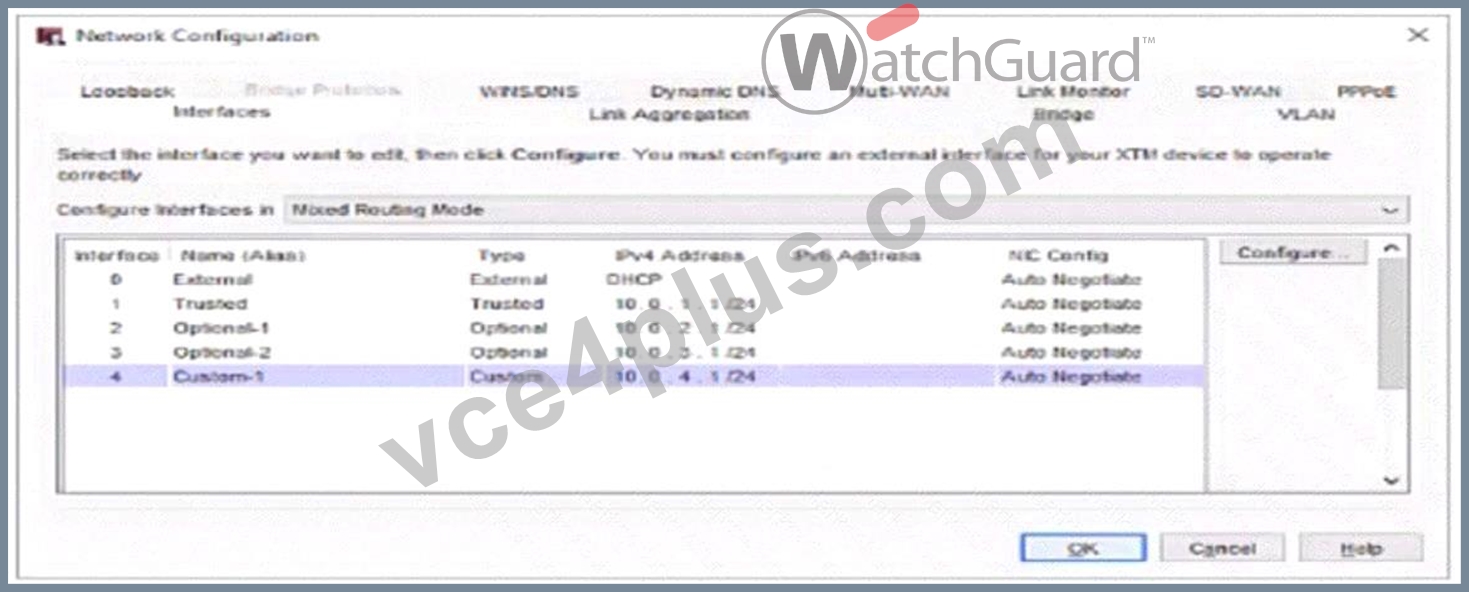
- A. Any
- B. Any-Trusted
- C. Optional-1
- D. Any-Optional
- E. Any-External
Answer: A,C,D
Explanation:
In the network configuration image provided, the interfaceOptional-1is mapped toEth2. Here's how the aliases work:
* Optional-1: Directly includes Eth2 since it's configured as Optional-1 in the network configuration.
* Any-Optional: This alias includes all optional interfaces, which would cover Eth2 as it is associated with Optional-1.
* Any: The "Any" alias includes all interfaces on the Firebox, covering all Trusted, Optional, and External interfaces. Thus, Eth2 is part of this alias by default.
Aliases likeAny-TrustedandAny-Externalwould not include Eth2 since it is configured as an Optional interface, not Trusted or External.
NEW QUESTION # 33
......
Valid Network-Security-Essentials Exam Updates - 2025 Study Guide: https://dumpsstar.vce4plus.com/WatchGuard/Network-Security-Essentials-valid-vce-dumps.html