

Updated Mar-2026 Official licence for FCSS_SASE_AD-25 Certified by FCSS_SASE_AD-25 Dumps PDF
Grab latest Amazon FCSS_SASE_AD-25 Dumps as PDF Updated on 2026
Fortinet FCSS_SASE_AD-25 Exam Syllabus Topics:
| Topic | Details |
|---|---|
| Topic 1 |
|
| Topic 2 |
|
| Topic 3 |
|
| Topic 4 |
|
NEW QUESTION # 13
Your organization is currently using FortiSASE for its cybersecurity. They have recently hired a contractor who will work from the HQ office and who needs temporary internet access in order to set up a web-based point of sale (POS) system.
What is the recommended way to provide internet access to the contractor?
- A. Use FortiClient on the endpoint to manage internet access.
- B. Use a proxy auto-configuration (PAC) file and provide secure web gateway (SWG) service as an explicit web proxy.
- C. Use zero trust network access (ZTNA) and tag the client as an unmanaged endpoint.
- D. Configure a VPN policy on FortiSASE to provide access to the internet.
Answer: C
Explanation:
The recommended way to provide temporary internet access to the contractor is to use Zero Trust Network Access (ZTNA) and tag the client as an unmanaged endpoint . ZTNA ensures that only authorized users and devices can access specific resources, while treating all endpoints as untrusted by default. By tagging the contractor's device as an unmanaged endpoint, you can apply strict access controls and ensure that the contractor has limited access to only the necessary resources (e.g., the web-based POS system) without exposing the internal network to unnecessary risks.
Here's why the other options are less suitable:
A . Use FortiClient on the endpoint to manage internet access: While FortiClient provides endpoint security and management, it requires installation and configuration on the contractor's device. This may not be feasible for temporary contractors or unmanaged devices.
B . Use a proxy auto-configuration (PAC) file and provide secure web gateway (SWG) service as an explicit web proxy: While this approach can control web traffic, it does not provide the granular access control and security posture validation offered by ZTNA. Additionally, managing PAC files can be cumbersome and less secure compared to ZTNA.
D . Configure a VPN policy on FortiSASE to provide access to the internet: Using a VPN policy would grant broader access to the network, which is not ideal for a temporary contractor. It increases the risk of unauthorized access to internal resources and does not align with the principle of least privilege.
Fortinet FCSS FortiSASE Documentation - Zero Trust Network Access (ZTNA) Use Cases FortiSASE Administration Guide - Managing Unmanaged Endpoints
NEW QUESTION # 14
How do security profile group objects behave when central management is enabled on FortiSASE?
- A. Objects support two-way synchronization.
- B. Objects that are only flow-based are supported.
- C. Objects created on FortiSASE can be retrieved on FortiManager.
- D. Objects are considered read-only on FortiSASE.
Answer: D
Explanation:
When central management is enabled, security profile group objects are managed exclusively through FortiManager, making them read-only on the FortiSASE portal to ensure centralized policy control.
NEW QUESTION # 15
Refer to the exhibits.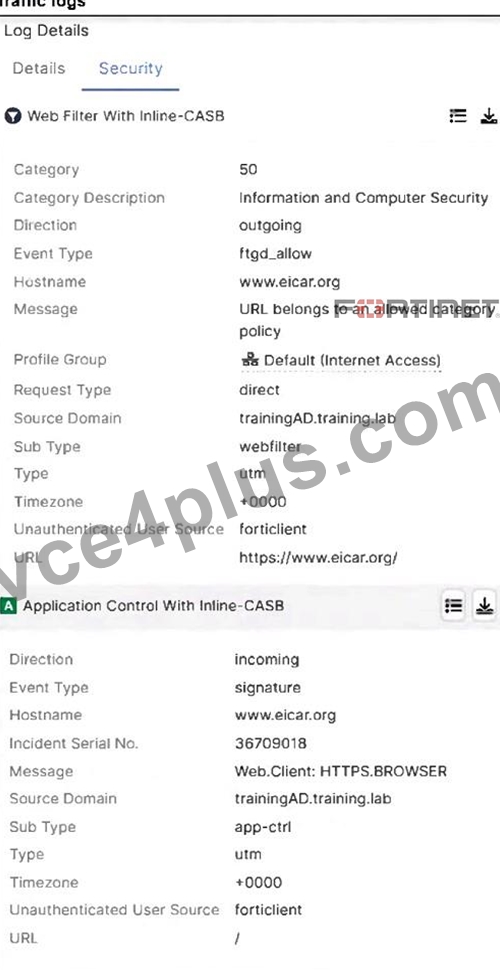
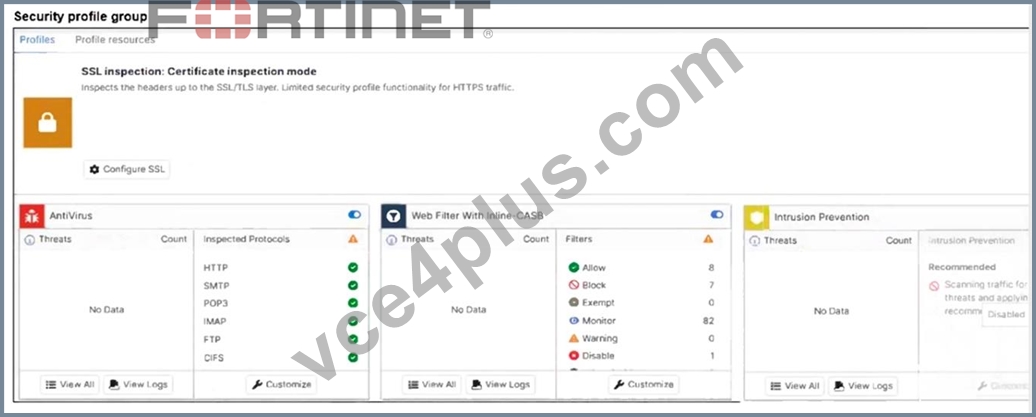
A FortiSASE administrator has configured an antivirus profile in the security profile group and applied it to the internet access policy. Remote users are still able to download the eicar.com-zip file from https://eicar.org.
Which configuration on FortiSASE is allowing users to perform the download?
- A. Application control is exempting all the browser traffic.
- B. Web filter is allowing the URL.
- C. Intrusion prevention is disabled.
- D. Deep inspection is not enabled.
Answer: D
Explanation:
The SSL inspection mode is set to certificate inspection, which only inspects SSL/TLS headers and does not allow full scanning of encrypted content. Without full (deep) inspection, the antivirus profile cannot scan or block malicious files (like eicar.com-zip) delivered over HTTPS, allowing the download to proceed.
NEW QUESTION # 16
When accessing the FortiSASE portal for the first time, an administrator must select data center locations for which three FortiSASE components? (Choose three.)
- A. Endpoint management
- B. Logging
- C. Authentication
- D. Points of presence
- E. SD-WAN hub
Answer: A,B,D
Explanation:
When accessing the FortiSASE portal for the first time, an administrator must select data center locations for the following FortiSASE components:
Endpoint Management:
The data center location for endpoint management ensures that endpoint data and policies are managed and stored within the chosen geographical region.
Points of Presence (PoPs):
Points of Presence (PoPs) are the locations where FortiSASE services are delivered to users. Selecting PoP locations ensures optimal performance and connectivity for users based on their geographical distribution.
Logging:
The data center location for logging determines where log data is stored and managed. This is crucial for compliance and regulatory requirements, as well as for efficient log analysis and reporting.
FortiOS 7.2 Administration Guide: Details on initial setup and configuration steps for FortiSASE.
FortiSASE 23.2 Documentation: Explains the importance of selecting data center locations for various FortiSASE components.
NEW QUESTION # 17
Refer to the exhibit.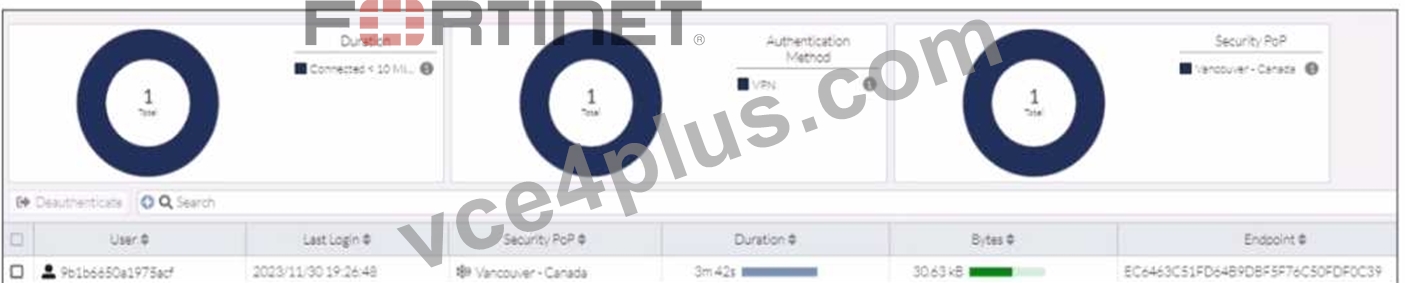
In the user connection monitor, the FortiSASE administrator notices the user name is showing random characters. Which configuration change must the administrator make to get proper user information?
- A. Add more endpoint licenses on FortiSASE.
- B. Turn off log anonymization on FortiSASE.
- C. Configure the username using FortiSASE naming convention.
- D. Change the deployment type from SWG to VPN.
Answer: B
Explanation:
In the user connection monitor, the random characters shown for the username indicate that log anonymization is enabled. Log anonymization is a feature that hides the actual user information in the logs for privacy and security reasons. To display proper user information, you need to disable log anonymization.
Log Anonymization:
When log anonymization is turned on, the actual usernames are replaced with random characters to protect user privacy.
This feature can be beneficial in certain environments but can cause issues when detailed user monitoring is required.
Disabling Log Anonymization:
Navigate to the FortiSASE settings.
Locate the log settings section.
Disable the log anonymization feature to ensure that actual usernames are displayed in the logs and user connection monitors.
FortiSASE 23.2 Documentation: Provides detailed steps on enabling and disabling log anonymization.
Fortinet Knowledge Base: Explains the impact of log anonymization on user monitoring and logging.
NEW QUESTION # 18
Which information can an administrator monitor using reports generated on FortiSASE?
- A. SD-WAN performance
- B. FortiSASE administrator and system events
- C. FortiClient vulnerability assessment
- D. sanctioned and unsanctioned Software-as-a-Service (SaaS) applications usage
Answer: D
Explanation:
FortiSASE reporting provides visibility into the usage of sanctioned and unsanctioned SaaS applications, enabling administrators to monitor cloud application activity and enforce security policies.
NEW QUESTION # 19
You are designing a new network for Company X and one of the new cybersecurity policy requirements is that all remote user endpoints must always be connected and protected Which FortiSASE component facilitates this always-on security measure?
- A. unified FortiClient
- B. site-based deployment
- C. inline-CASB
- D. thin-branch SASE extension
Answer: A
Explanation:
The unified FortiClient component of FortiSASE facilitates the always-on security measure required for ensuring that all remote user endpoints are always connected and protected.
Unified FortiClient:
FortiClient is a comprehensive endpoint security solution that integrates with FortiSASE to provide continuous protection for remote user endpoints.
It ensures that endpoints are always connected to the FortiSASE infrastructure, even when users are off the corporate network.
Always-On Security:
The unified FortiClient maintains a persistent connection to FortiSASE, enforcing security policies and protecting endpoints against threats at all times.
This ensures compliance with the cybersecurity policy requiring constant connectivity and protection for remote users.
FortiOS 7.2 Administration Guide: Provides information on configuring and managing FortiClient for endpoint security.
FortiSASE 23.2 Documentation: Explains how FortiClient integrates with FortiSASE to deliver always-on security for remote endpoints.
NEW QUESTION # 20
Refer to the exhibit.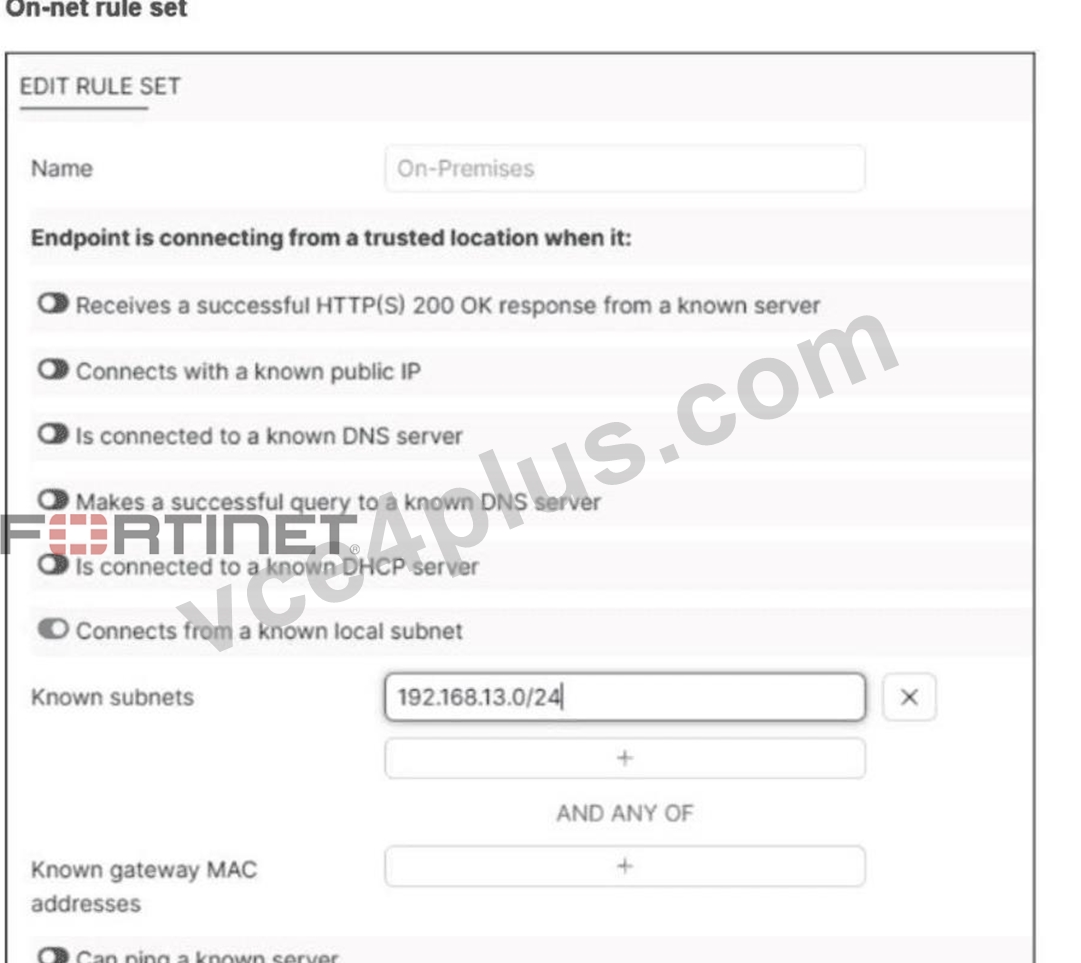
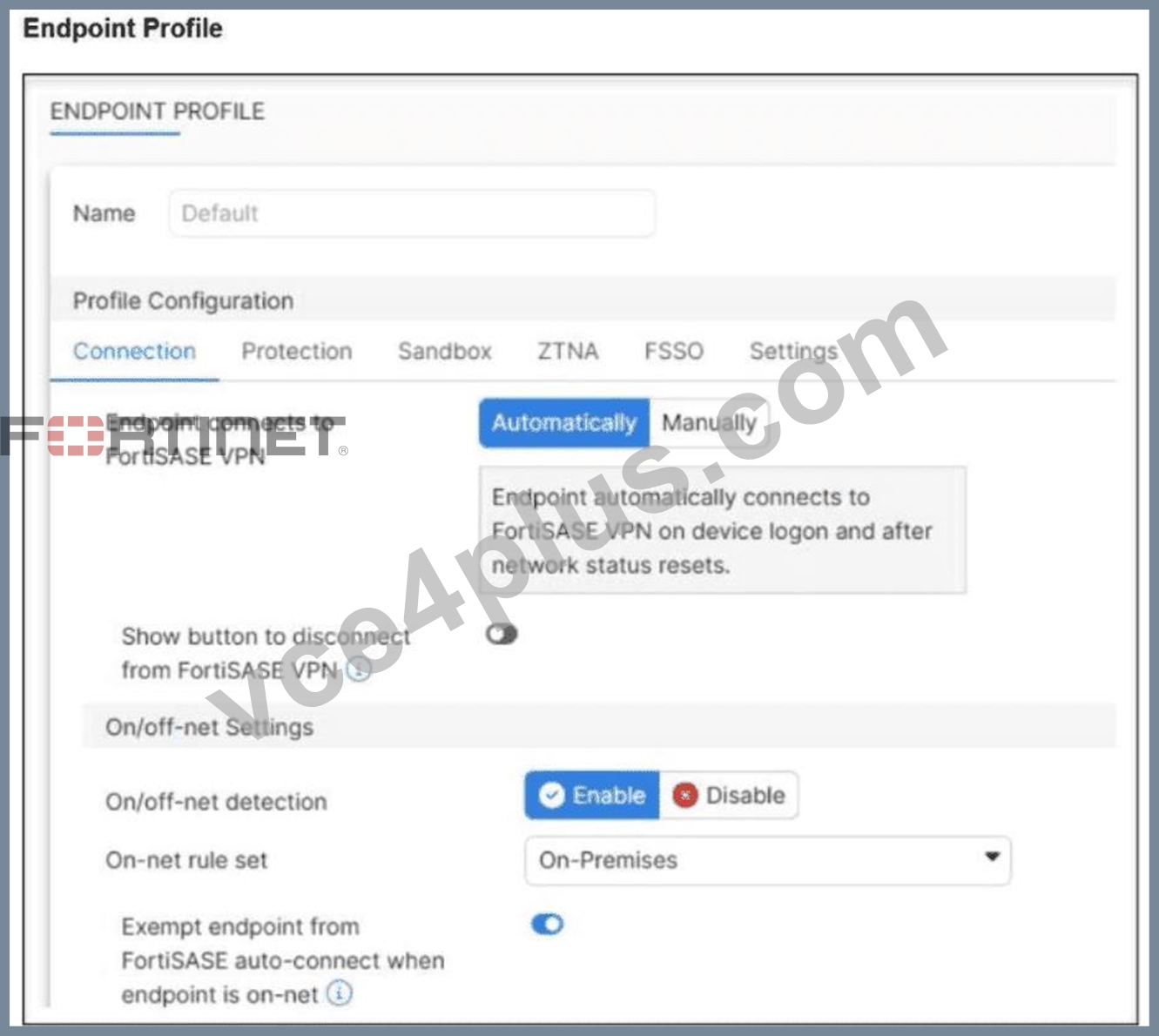
An endpoint is assigned an IP address of 192.168.13.101/24.
Which action will be run on the endpoint?
- A. The endpoint will automatically connect to the FortiSASE tunnel.
- B. The endpoint will be detected as off-net.
- C. The endpoint will be able to bypass the on-net rule because it is connecting from a known subnet.
- D. The endpoint will be exempted from auto-connect to the FortiSASE tunnel.
Answer: D
Explanation:
The FortiClient Administration Guide states that on-net rules determine when an endpoint is in a trusted location. If the endpoint matches the configured subnet, the client is considered on-net, and therefore bypasses auto-connect.
* "Device registration and on-net status information for a device that is running FortiClient appears only on the FortiGate that applies the FortiClient profile to that device." Since 192.168.13.101 falls inside the trusted subnet 192.168.13.0/24, the endpoint is treated as on-net # it will be exempted from auto-connect.
NEW QUESTION # 21
Refer to the exhibits.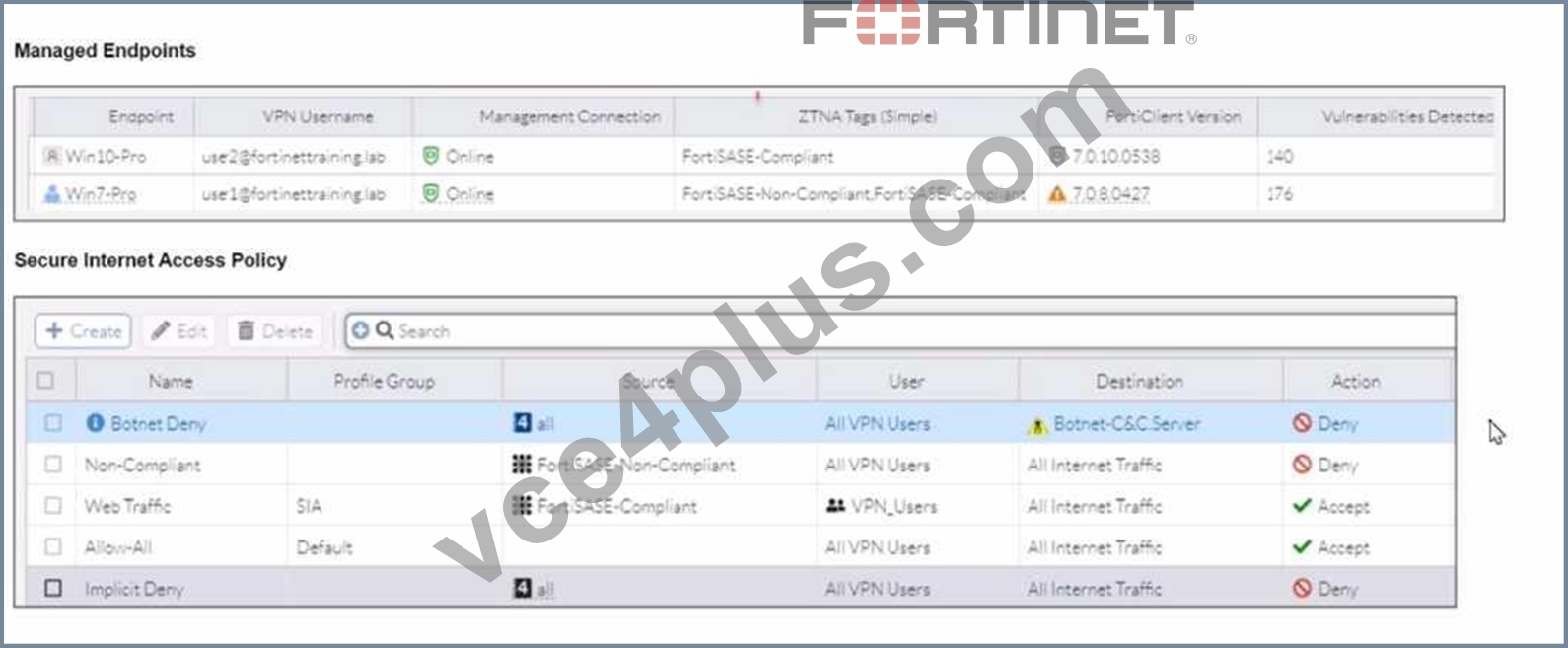
WiMO-Pro and Win7-Pro are endpoints from the same remote location. WiMO-Pro can access the internet though FortiSASE, while Wm7-Pro can no longer access the internet Given the exhibits, which reason explains the outage on Wm7-Pro?
- A. Win7-Pro cannot reach the FortiSASE SSL VPN gateway
- B. The Win7-Pro device posture has changed.
- C. Win-7 Pro has exceeded the total vulnerability detected threshold.
- D. The Win7-Pro FortiClient version does not match the FortiSASE endpoint requirement.
Answer: C
Explanation:
Based on the provided exhibits, the reason why the Win7-Pro endpoint can no longer access the internet through FortiSASE is due to exceeding the total vulnerability detected threshold. This threshold is used to determine if a device is compliant with the security requirements to access the network.
Endpoint Compliance:
FortiSASE monitors endpoint compliance by assessing various security parameters, including the number of vulnerabilities detected on the device.
The compliance status is indicated by the ZTNA tags and the vulnerabilities detected.
Vulnerability Threshold:
The exhibit shows that Win7-Pro has 176 vulnerabilities detected, whereas Win10-Pro has 140 vulnerabilities.
If the endpoint exceeds a predefined vulnerability threshold, it may be restricted from accessing the network to ensure overall network security.
Impact on Network Access:
Since Win7-Pro has exceeded the vulnerability threshold, it is marked as non-compliant and subsequently loses internet access through FortiSASE.
The FortiSASE endpoint profile enforces this compliance check to prevent potentially vulnerable devices from accessing the internet.
FortiOS 7.2 Administration Guide: Provides information on endpoint compliance and vulnerability management.
FortiSASE 23.2 Documentation: Explains how vulnerability thresholds are used to determine endpoint compliance and access control.
NEW QUESTION # 22
Which two components are part of onboarding a secure web gateway (SWG) endpoint for secure internet access (SIA)? (Choose two.)
- A. proxy auto-configuration (PAC) file
- B. FortiClient software
- C. tunnel policy
- D. FortiSASE certificate authority (CA) certificate
Answer: A,B
Explanation:
A PAC file is used to redirect client web traffic through the SWG, and FortiClient software is required to connect endpoints to the FortiSASE service for secure internet access (SIA).
NEW QUESTION # 23
To complete their day-to-day operations, remote users require access to a TCP-based application that is hosted on a private web server. Which FortiSASE deployment use case provides the most efficient and secure method for meeting the remote users' requirements?
- A. zero trust network access (ZTNA) private access
- B. inline-CASB
- C. next generation firewall (NGFW)
- D. SD-WAN private access
Answer: A
Explanation:
Zero Trust Network Access (ZTNA) private access provides the most efficient and secure method for remote users to access a TCP-based application hosted on a private web server. ZTNA ensures that only authenticated and authorized users can access specific applications based on predefined policies, enhancing security and access control.
Zero Trust Network Access (ZTNA):
ZTNA operates on the principle of "never trust, always verify," continuously verifying user identity and device security posture before granting access.
It provides secure and granular access to specific applications, ensuring that remote users can securely access the TCP-based application hosted on the private web server.
Secure and Efficient Access:
ZTNA private access allows remote users to connect directly to the application without needing a full VPN tunnel, reducing latency and improving performance.
It ensures that only authorized users can access the application, providing robust security controls.
FortiOS 7.2 Administration Guide: Provides detailed information on ZTNA and its deployment use cases.
FortiSASE 23.2 Documentation: Explains how ZTNA can be used to provide secure access to private applications for remote users.
NEW QUESTION # 24
What are two advantages of using zero-trust tags? (Choose two.)
- A. Zero-trust tags can be used to allow secure web gateway (SWG) access
- B. Zero-trust tags can determine the security posture of an endpoint.
- C. Zero-trust tags can be used to create multiple endpoint profiles which can be applied to different endpoints
- D. Zero-trust tags can be used to allow or deny access to network resources
Answer: B,D
NEW QUESTION # 25
What are the advantages of using automated scripts for bulk user registration in FortiSASE?
(Select all that apply)
- A. Increased risk of security breaches
- B. Consistent user credential management
- C. Streamlined user onboarding
- D. Reduced administrative overhead
Answer: B,C,D
NEW QUESTION # 26
Which service is included in a secure access service edge (SASE) solution, but not in a security service edge (SSE) solution?
- A. SD-WAN
- B. ZTNA
- C. CASB
- D. SWG
Answer: A
Explanation:
SD-WAN is a networking component included in a SASE solution but not in an SSE solution. SSE focuses solely on security services (like ZTNA, SWG, and CASB), while SASE combines both networking (e.g., SD- WAN) and security into a unified cloud-delivered service.
NEW QUESTION # 27
Which statement best describes the Digital Experience Monitor (DEM) feature on FortiSASE?
- A. It can be used to request a detailed analysis of the endpoint from the FortiGuard team.
- B. It requires a separate DEM agent to be downloaded from the FortiSASE portal and installed on the endpoint.
- C. It provides end-to-end network visibility from all the FortiSASE security PoPs to a specific SaaS application.
- D. It can help IT and security teams ensure consistent security monitoring for remote users.
Answer: C
Explanation:
The Digital Experience Monitor (DEM) feature in FortiSASE is designed to provide end-to-end network visibility by monitoring the performance and health of connections between FortiSASE security Points of Presence (PoPs) and specific SaaS applications. This ensures that administrators can identify and troubleshoot issues related to latency, jitter, packet loss, and other network performance metrics that could impact user experience when accessing cloud-based services.
Here's why the other options are incorrect:
B . It can be used to request a detailed analysis of the endpoint from the FortiGuard team: This is incorrect because DEM focuses on network performance monitoring, not endpoint analysis. Endpoint analysis would typically involve tools like FortiClient or FortiEDR, not DEM.
C . It requires a separate DEM agent to be downloaded from the FortiSASE portal and installed on the endpoint: This is incorrect because DEM operates at the network level and does not require an additional agent to be installed on endpoints.
D . It can help IT and security teams ensure consistent security monitoring for remote users: While DEM indirectly supports security by ensuring optimal network performance, its primary purpose is to monitor and improve the digital experience rather than enforce security policies.
Fortinet FCSS FortiSASE Documentation - Digital Experience Monitoring Overview FortiSASE Administration Guide - Configuring DEM
NEW QUESTION # 28
Which two of the following can release the network lockdown on the endpoint applied by FortiSASE?
(Choose two.)\
- A. When the endpoint is rebooted
- B. When the endpoint connects to the FortiSASE tunnel
- C. When the endpoint is determined as compliant using ZTNA tags
- D. When the endpoint is determined as on-net
Answer: B,C
Explanation:
FortiSASE releases network lockdown when the endpoint re-establishes the tunnel connection or when it is verified as compliant through ZTNA tag evaluation, ensuring it meets security posture requirements.
NEW QUESTION # 29
Which two components are part of onboarding a secure web gateway (SWG) endpoint? (Choose two)
- A. FortiClient installer
- B. proxy auto-configuration (PAC) file
- C. FortiSASE invitation code
- D. FortiSASE CA certificate
Answer: B,D
Explanation:
Onboarding a Secure Web Gateway (SWG) endpoint involves several components to ensure secure and effective integration with FortiSASE. Two key components are the FortiSASE CA certificate and the proxy auto-configuration (PAC) file.
FortiSASE CA Certificate:
The FortiSASE CA certificate is essential for establishing trust between the endpoint and the FortiSASE infrastructure.
It ensures that the endpoint can securely communicate with FortiSASE services and inspect SSL/TLS traffic.
Proxy Auto-Configuration (PAC) File:
The PAC file is used to configure the endpoint to direct web traffic through the FortiSASE proxy.
It provides instructions on how to route traffic, ensuring that all web requests are properly inspected and filtered by FortiSASE.
FortiOS 7.2 Administration Guide: Details on onboarding endpoints and configuring SWG.
FortiSASE 23.2 Documentation: Explains the components required for integrating endpoints with FortiSASE and the process for deploying the CA certificate and PAC file.
NEW QUESTION # 30
Which statement applies to a single sign-on (SSO) deployment on FortiSASE?
- A. SSO users can be imported into FortiSASE and added to user groups.
- B. SSO is recommended only for agent-based deployments.
- C. SSO identity providers can be integrated using public and private access types.
- D. SSO overrides any other previously configured user authentication.
Answer: D
Explanation:
In FortiSASE, Single Sign-On (SSO) takes precedence and overrides other configured user authentication methods, ensuring a centralized and streamlined authentication process across services.
NEW QUESTION # 31
Refer to the exhibit.
While reviewing the traffic logs, the FortiSASE administrator notices that the usernames are showing random characters.
Why are the usernames showing random characters?
- A. Users are using a shared single sign-on SSO username.
- B. Special characters are used in usernames.
- C. FortiSASE uses FortiClient unique identifiers for usernames.
- D. Log anonymization is turned on to hash usernames.
Answer: D
Explanation:
The usernames appear as random character strings because log anonymization is enabled in FortiSASE, which hashes sensitive user information such as usernames to protect privacy while still allowing log analysis.
NEW QUESTION # 32
Refer to the exhibits.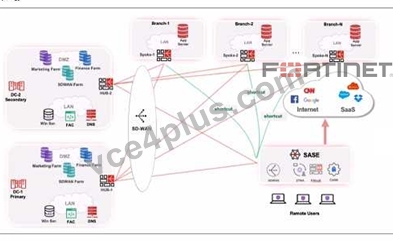
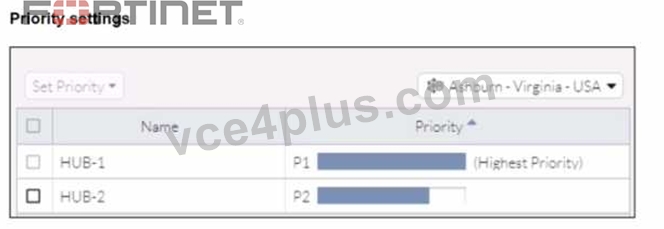
When remote users connected to FortiSASE require access to internal resources on Branch-2. how will traffic be routed?
- A. FortiSASE will use the AD VPN protocol and determine that traffic will be directed to Branch-2 directly, using a dynamic route
- B. FortiSASE will use the SD-WAN capability and determine that traffic will be directed to HUB-2. which will then route traffic to Branch-2.
- C. FortiSASE will use the SD-WAN capability and determine that traffic will be directed to HUB-1, which will then route traffic to Branch-2.
- D. FortiSASE will use the AD VPN protocol and determine that traffic will be directed to Branch-2 directly, using a static route
Answer: A
NEW QUESTION # 33
How does FortiSASE hide user information when viewing and analyzing logs?
- A. By encrypting data using advanced encryption standard (AES)
- B. By encrypting data using Secure Hash Algorithm 256-bit (SHA-256)
- C. By hashing data using Blowfish
- D. By hashing data using salt
Answer: D
Explanation:
FortiSASE hides user information when viewing and analyzing logs by hashing data using salt. This approach ensures that sensitive user information is obfuscated, enhancing privacy and security.
Hashing Data with Salt:
Hashing data involves converting it into a fixed-size string of characters, which is typically a hash value.
Salting adds random data to the input of the hash function, ensuring that even identical inputs produce different hash values.
This method provides enhanced security by making it more difficult to reverse-engineer the original data from the hash value.
Security and Privacy:
Using salted hashes ensures that user information remains secure and private when stored or analyzed in logs.
This technique is widely used in security systems to protect sensitive data from unauthorized access.
FortiOS 7.2 Administration Guide: Provides information on log management and data protection techniques.
FortiSASE 23.2 Documentation: Details on how FortiSASE implements data hashing and salting to secure user information in logs.
NEW QUESTION # 34
Refer to the exhibits.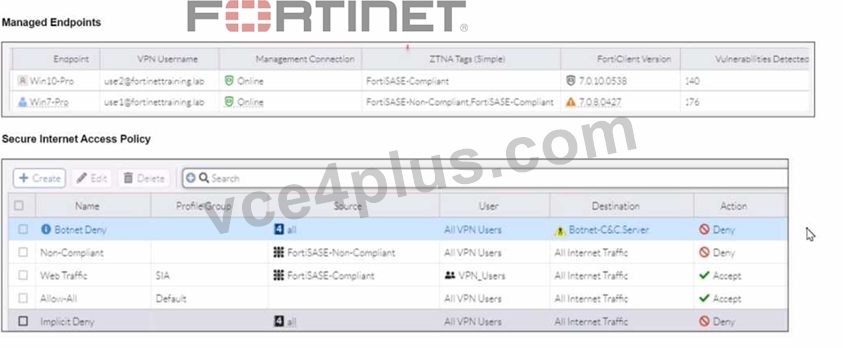
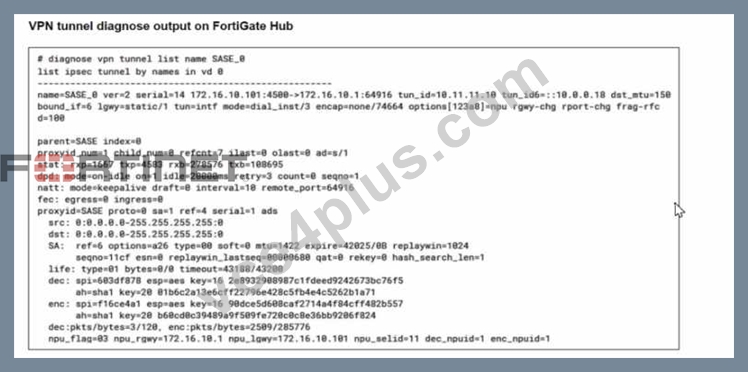
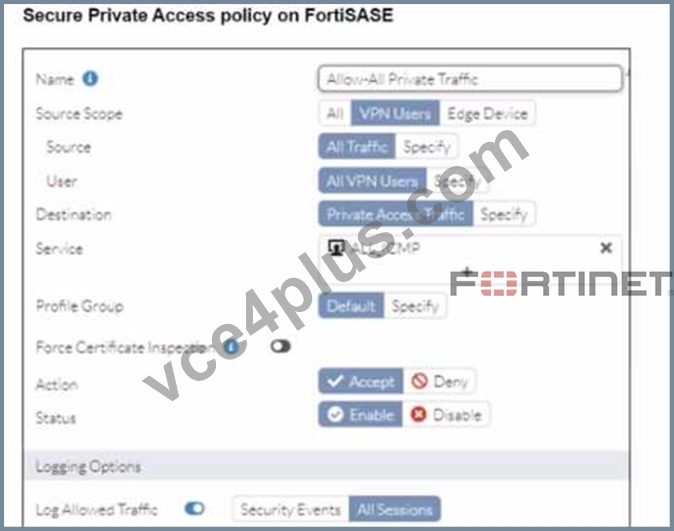
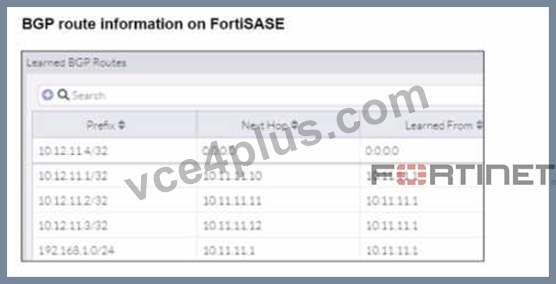
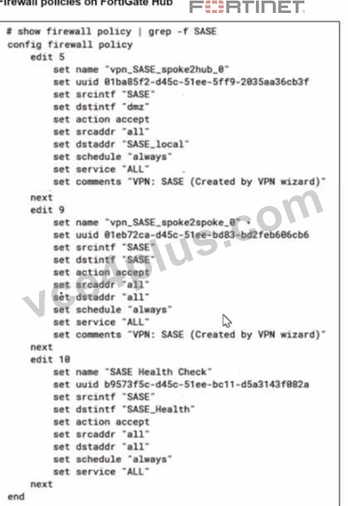
A FortiSASE administrator is trying to configure FortiSASE as a spoke to a FortiGate hub. The tunnel is up to the FortiGale hub. However, the administrator is not able to ping the webserver hosted behind the FortiGate hub. Based on the output, what is the reason for the ping failures?
- A. The BGP route is not received.
- B. The Secure Private Access (SPA) policy needs to allow PING service.
- C. Network address translation (NAT) is not enabled on the spoke-to-hub policy.
- D. Quick mode selectors are restricting the subnet.
Answer: A
NEW QUESTION # 35
......
Latest FCSS_SASE_AD-25 Exam Dumps Fortinet Exam from Training: https://dumpsstar.vce4plus.com/Fortinet/FCSS_SASE_AD-25-valid-vce-dumps.html